Prosecuted for Obeying the Law

I am a physician who was sentenced to five years in federal prison after relying on Section 861 of Subchapter N of the Internal Revenue Code. Section 861 uses location words. It says that citizens or residents with income from inside the United States are taxed only when they have foreign employers. Those location words make the federal income tax a cross-border tax.
Since 1862, federal judges have assumed that domestic income is taxable instead of applying the location words showing the cross-border limit. I used Section 861 to show why my domestic income was not taxable, but federal judges said that everyone owes the tax. During my case, the judge kept the jury from seeing Section 861 and told them they had to follow HIS OPINION that all income is taxable. This substitution resulted in my conviction for a crime that I did not commit.
Years later, I discovered that Section 7701—Definitions, which must be used throughout the Code, confirms Subchapter N. Together, Section 7701 and Subchapter N show that income becomes taxable only when it crosses national borders. Federal judges have never applied the rules defining that cross-border limit. Instead, they begin with the tax-imposed sections and assume a domestic tax.
Using only the Internal Revenue Code, which is the law, Congress did not impose an income tax on the domestic income of citizens or residents inside the United States.
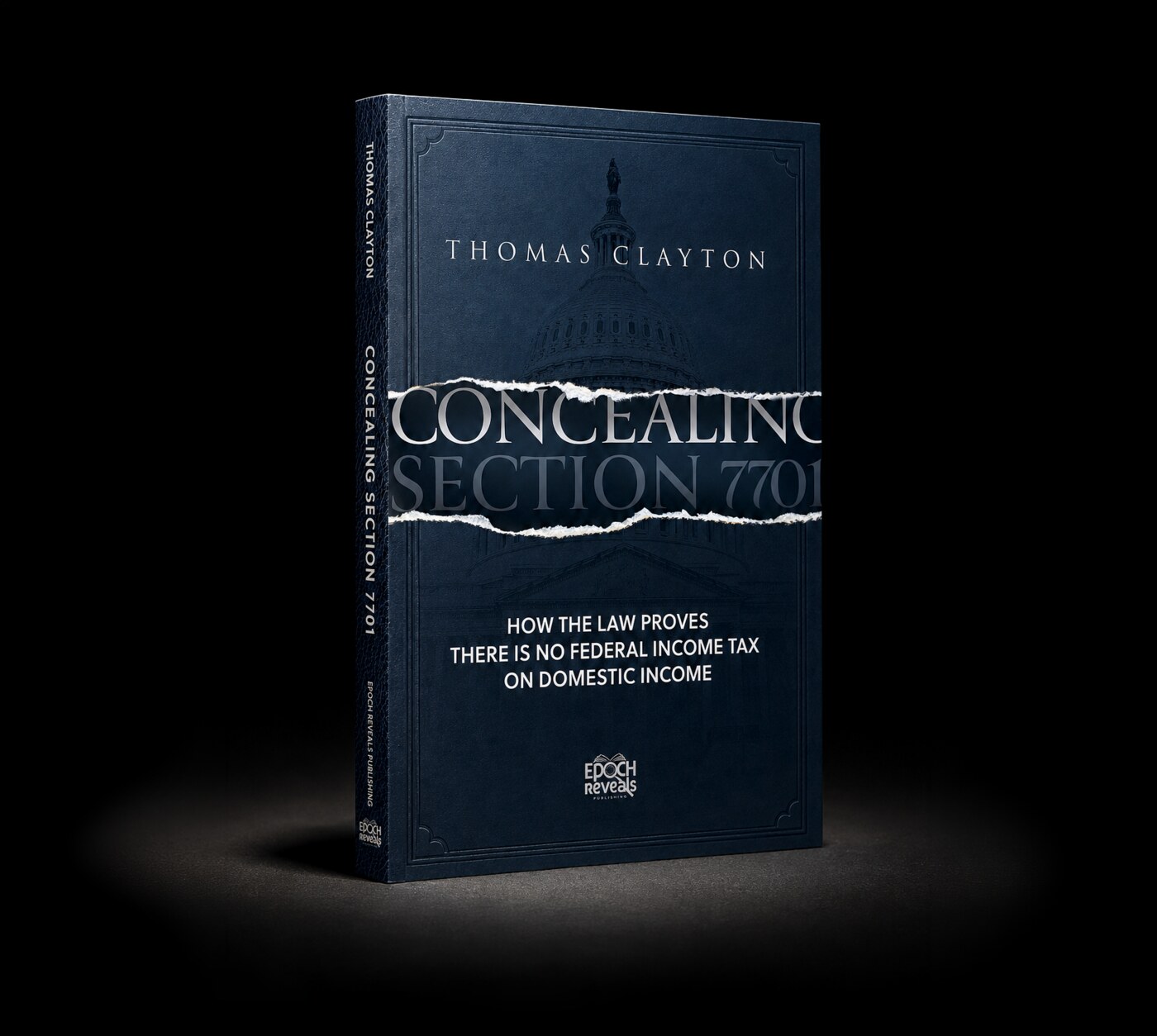
What This Book Shows
- The Internal Revenue Code contains rules that ensure accurate results.
- Section 7701 identifies who is taxed.
- "Individuals," "persons," and "taxpayers" mean foreigners outside the United States.
- Subchapter N contains the location words showing that only cross-border income is taxable.
Location Words Reveal the Limit
- The same location structure has existed since 1862.
- Income recipients are divided by location.
- Income origin is divided by location.
- Section 7701 identifies who receives the income.
- Subchapter N identifies when income becomes taxable.
- Income is taxable only when it crosses national borders.
- Income that remains inside the United States is not taxable.
Meet Tom Clayton, MD
Unmasking the Crucial Sections
Dr. Tom Clayton is a physician with a background in pure mathematics. He has always followed rules exactly to avoid mistakes. After a medical career with no quality issues, he wanted to know why tax advisors and the IRS kept making the same mistakes about the income tax.
When their rules are followed, the IRC and its predecessors are not subject to debate. Similar to a tariff, the income tax applies only when income crosses national borders. Beginning in 1863, the Commissioner of Internal Revenue assumed the income tax applied inside the United States. Federal judges adopted that assumption. But according to 164 years of income tax statutes, there has never been an income tax on citizens or residents inside the United States with domestic income.
The key is location words. Words such as “within,” “without,” “from,” and “outside” show where income, people, and activities are located before any tax can be applied. Present in all income tax statutes since 1862, those words are now found in Subchapter N, “Tax Based on Income From Sources Within or Without the United States.”
Because the tax-imposed sections do not cross-reference Section 7701 or Subchapter N, federal judges, tax advisors, and the IRS continue to make the same incorrect assumption, misapplying the tax inside the United States.
Tom Clayton, MD

Why I Wrote the Book
- I trusted the written law.
- I searched the Code directly
- I found rules that had been skipped.
- Section 7701 defines the legal words.
- Subchapter N contains the location words.
- The income tax applies when income crosses national borders.
- Federal judges kept those rules from the jury.
- This book shows what the Code actually says.
Click on the Dog and Pony Show Section header and individual chapters for more details.
Get In Touch
Curious? Angry? Just want to know more? This book is for you. Reserve your copy of the book now: